
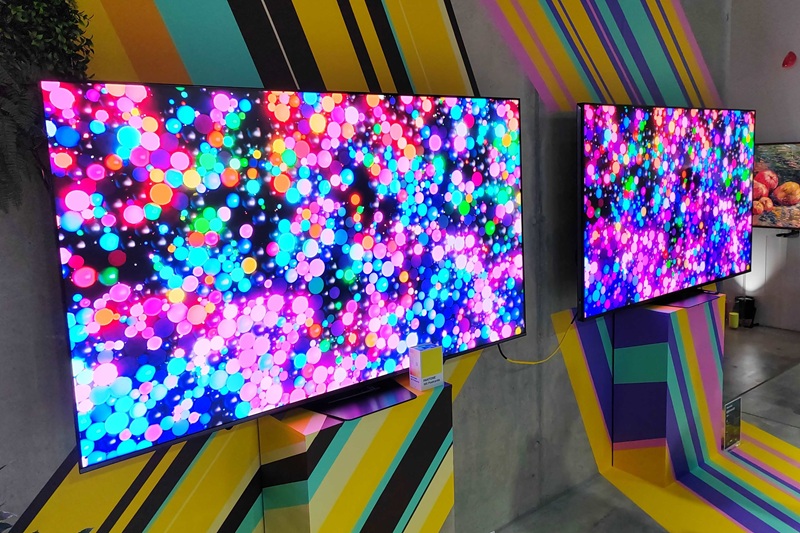
Hisense used its trade showcase in Munich to position itself as the “origin of RGB-MiniLED TV,” doubling down on the next-gen TV technology for 2026, while expanding its large-screen fleet, and championing Freely integration. Steve May reports.
The brand, which recorded a 2.5 per cent year-on-year increase in value, at a time when rivals saw declines, also claimed the No.2 TV brand position by volume for July–December 2025, as well as the No.1 spot in 100-inch Super Large TVs over the same period.
Unlike conventional Mini LED backlighting, RGB-MiniLED uses red, green and blue LEDs for precision local dimming, generating colour directly at source. Consumer benefits include higher brightness, greater colour purity and tighter local contrast control, particularly useful in bright living rooms and gaming environments.
Leading the Hisense high-end charge is the UR9, available in 65-, 75- and 85-inch screen sizes. This flagship RGB-MiniLED TV delivers up to 4,000 nits peak brightness, and employs an anti-reflection, glare-free screen treatment, making it especially effective in brightly lit environments.
At its core is the Hi-View AI Engine RGB, the brand’s most advanced picture processor to date, designed for real-time optimisation of resolution, colour, contrast and motion.
The UR9 also integrates a 4.1.2-channel sound system tuned by Devialet, combining up-firing height channels, dedicated surround drivers and a built-in subwoofer to create a more enveloping Dolby Atmos presentation.
With Dolby Vision, Dolby Vision IQ, HDR10+ and HLG, alongside FreeSync Premium Pro, and support for a 180Hz native refresh rate, it’s a strong proposition for both cinema and gaming.
Positioned just below the UR9 is the UR8, which broadens the range with 55-, 65-, 75-, 85- and 100-inch options. It retains much of the flagship’s appeal, offering 3,500 nits peak brightness, a native 180Hz Game Mode, anti-reflection and anti-glare treatment, and the same Hi-View AI Engine processing philosophy.
Its 2.1.2-channel Devialet-tuned sound system lends it strong audio credibility too. The inclusion of a 100-inch screen size is especially relevant for retailers capitalising on the continued shift towards extra-large home cinema displays.
Supporting the RGB-MiniLED range is the U8Q, designated Mini LED Pro, and available from 55 inches right up to 100 inches. Interestingly, this model is capable of an even higher 5,000 nits peak brightness.
Additional specs include a 165Hz Game mode, 4.1.2 Dolby Atmos sound system and Anti Reflection Pro screen treatment.
Further down the range, the U7S Pro and U7S continue the Mini LED story in 55-, 65-, 75-, 85- and 100-inch sizes.
The U7S Pro offers 3,000 nits peak brightness, 165Hz Game Mode, and a 2.1.2-channel Dolby Atmos sound system, again tuned by Devialet. The U7S, meanwhile, lowers peak brightness to 1,400 nits.
At the more affordable end of the Hisense lineup sits the E8S, a Hi-QLED MiniLED model offered in 55-, 65-, 75- and 85-inch sizes.
Hisense is maintaining Freely across its range, noting it has now shipped more than one million Freely-enabled TVs.
At the event, the brand also stated that the growing ‘lifestyle’ screen sector would be a core focus. It offered three screens designed with “life aesthetics” in mind, a movable, battery powered touchscreen, a gallery style Canvas TV, and the stylish Deco small screen.
Gaming remains another focus. Hisense confirmed its continued Xbox cloud gaming integration through the VIDAA Xbox app, and revealed that for a limited time in May it would be offering buyers of select Hisense products a free Xbox controller.
Stay ahead in the Electrical Retail Industry
Never miss a beat in the world of electrical retail. Subscribe to our weekly newsletter for the latest industry news, insights, and trends – delivered straight to your inbox. Plus, receive ERT Magazine 10 times a year, bringing you the latest analysis, insights, and inspiration from across the industry.
Subscribe now: https://ertonline.co.uk/
