
Sony is hailing its new RGB LED TV display technology as the most significant advance in picture quality since the advent of OLED, writes Steve May. Unveiling an 85-inch prototype, behind the scenes at IFA 2025, Daisuke Nezu, Senior General Manager and Head of Home Product Business, said, “RGB panel technology holds enormous potential to redefine how content is experienced.”
The ground-breaking RGB LED display reimagines the traditional LED backlight and does away with a Quantum Dot filter, in favour of a full RGB LED diode array, which brings greater colour volume and brightness. Said to cover over 99 per cent of the DCI-P3 colour space and approximately 90 per cent of the BT.2020 colour standard, the benefit is exceptionally precise backlight illumination with outstanding HDR intensity.
ERT had an exclusive preview of the screen, which offers a peak brightness of 4000 nits; which far eclipses what is currently available in the premium TV market.
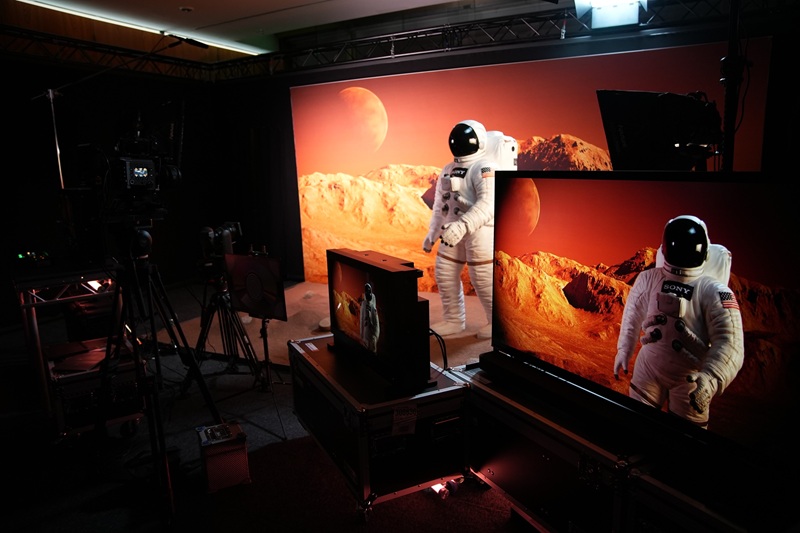
Sony staged its reveal on a faux shooting stage, complete with moonwalking astronaut, Sony Venice digital cinema camera and full workstation with master monitors, all to underline that Sony alone is involved at every aspect of TV and movie content production.

While key rivals, such as Samsung, TCL and Hisense are also developing comparable technologies, Gavin McCarron, Technical Marketing Manager for Sony TV Europe, insisted that its proprietary signal processing technology, honed by decades of movie production, was key to truly accurate picture quality.
The genesis of this RGB technology can be traced back 21 years, when Sony developed the world’s first LCD television with a full-array RGB LED backlight, for its famed Qualia line.
However, this new iteration represents a quantum leap forward. A shootout between the RGB LED newcomer, and similarly sized Mini LED TV and OLED panels, confirmed RGB LED, bolstered by Sony’s proprietary XR Backlight Master Drive, is not only significantly brighter, but offers a level of colour accuracy hitherto unseen at high street retail.
While Sony has yet to confirm just when its RGB LED TV will come to market (let’s assume 2026), Mr Nezu says that the technology is scalable, suggesting that the brand was more interested in downsizing the innovation to conventional screen sizes, such as 65- and 55-inches, than producing a 110-inch plus display as favoured by competitors.
For more IFA news, click here