
Five years after the first Sky Glass TV was launched, Sky is evolving the software that sits behind its connected television proposition, with new navigation, revised cloud recording, AI-powered voice search and a more consistent experience across Sky Glass, Sky Air, Sky Stream and mobile, reports Steve May.
Sky threw open the doors to its Osterley HQ, for an early look at the changes coming to Sky OS, with Sky Glass, Sky Stream, Gen Two and the new Sky Glass Air all set to benefit.
ERT was invited to look under the hood. The preview was very much about evolution rather than a wholesale reinvention of Sky OS. The interface remains recognisably Sky, but several familiar parts have been moved, renamed or expanded. The aim is to make the system feel easier to navigate and more intuitive.
There’s no confirmed launch date for the new features yet. Sky says it expects many of them to arrive before the end of 2026. The changes are built around three priorities: reducing the number of clicks needed to reach live TV and popular content, giving customers greater control over what they save and record, and creating a more consistent experience across TV and mobile devices.
Nine out of ten new Sky customers now choose a product from the current Glass, Stream and related portfolio.
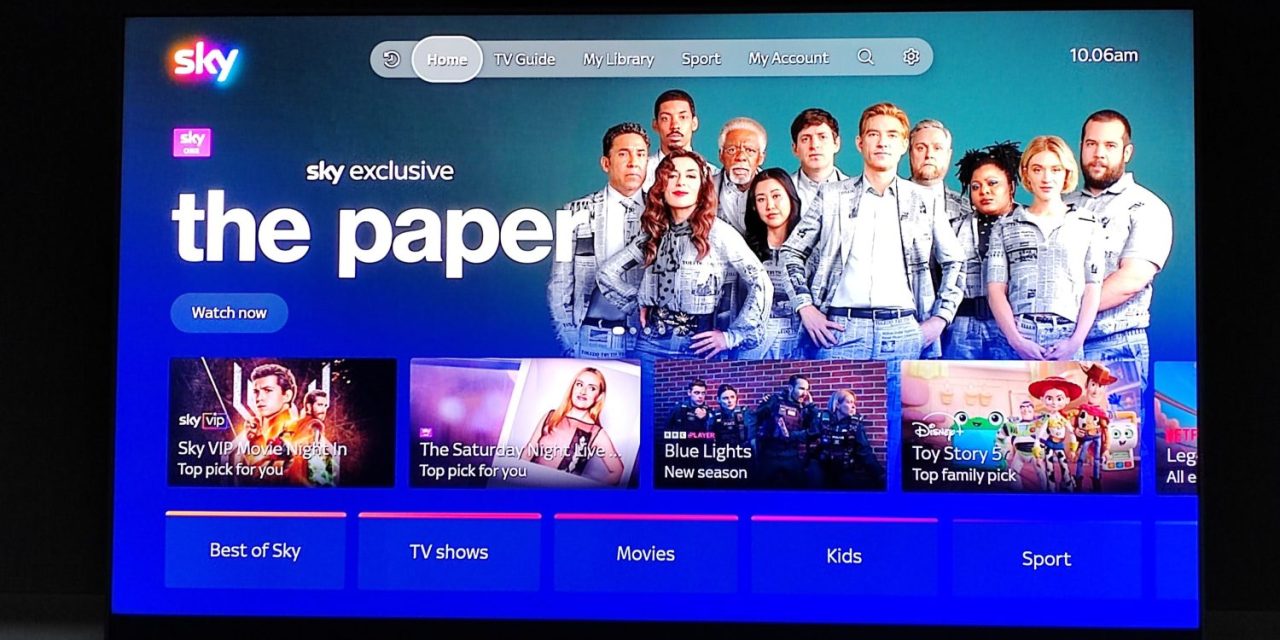
The most immediately visible change is the new top-level navigation bar. Home, TV Guide, My Library, Sport and My Account now have dedicated positions, alongside Search and Settings. A graphical ‘Recents’ shortcut provides quick access to recently watched programmes, channels and apps. It also brings the Continue Watching experience closer to the surface.
Sky is clearly trying to reduce the amount of archaeology involved in getting back to something you watched five minutes ago.
The Home screen is also under re-development, with video previews coming to the Home carousel. The aim is to make discovery more engaging, giving viewers a way to see more of a programme before deciding whether to open it.
The TV Guide will also get a series of practical changes. Day selection is clearer, channel logos have prominence and users can tune directly into live television from the guide. An improved mini-guide is also being introduced, alongside a shortcut for returning to the previous channel.
The restart rail is being removed from the main route through the guide. The functionality remains available elsewhere, so the change is primarily about simplifying the main navigation path.
My Library replaces Playlist
One of the more impactful changes is the replacement of the existing Playlist system with My Library.
My Library separates saved content into two distinct areas: Watchlist and Recordings. Recordings are programmes stored in Sky’s cloud recording system, while the Watchlist is where shows Sky can’t ‘record’ – such as everything on BBC iPlayer – can be accessed via the appropriate catch-up service..
Recording functionality is also being clarified. Viewers will be able to record individual programmes with familiar PVR-style controls (which will make the system more intuitive for those moving from Sky Q).
The system can save eligible content to the customer’s cloud allocation, while other programmes are effectively bookmarked and handed off to the relevant streaming service.
Sky is providing up to 1,000 hours of cloud recording capacity at account level. The company describes this as equivalent to around 500 days of Peppa Pig.
If the allocation is eventually reached, Sky says the system will automatically delete older recordings to make room for new ones. Customers therefore do not need to spend their evenings performing the digital equivalent of cleaning out a loft.
Sky gets conversational
The most interesting development from a technology perspective is the new Voice AI.
Sky’s existing voice system is being expanded into a more natural-language service designed around entertainment discovery. Rather than relying solely on conventional commands, customers will be able to ask questions in a more conversational manner and continue the interaction with follow-up requests.

That opens the door to queries based on imperfect memories. Say you remember part of a film, a television show or an actor without knowing the exact title. The new system is intended to understand your descriptions and help identify what you want to watch.
The idea is for Voice AI to act as an entertainment assistant within Sky OS, helping customers make viewing decisions as well as responding to conventional commands.
Sky describes the system as being “your entertainment assistant, it’s there by your side, integrated into the Sky experience you know and love today, but just helps you in making those decisions…”
The service remains focused on entertainment. Sky says safety guardrails are built into the system, reflecting its position as a consumer television platform rather than a general-purpose AI assistant.
The voice transcription mechanism currently used by Sky is also being changed. Transcription will become optional through the accessibility settings.
Voice search is something a customer can understand immediately when they see it working. Asking for a vaguely remembered film and receiving a useful response makes for a more tangible demonstration than a list of technical specifications.
Sky Go moves closer to the television experience
Sky is also rebuilding its Sky Go experience for Glass and Stream customers.
The new Sky Go app will use the same underlying system as the TV experience, with shared navigation, Continue Watching, My Library and downloads across TV and mobile.
There is still a gap though. At launch, customers will not be able to access programmes from My Library while they are away from home. Sky says this is something it is considering for future development.
The direction is clear, though. Sky wants the operating system to feel like one environment that happens to be available on different screens.
Sky has not yet confirmed exactly when every element of the revised Sky OS will arrive. The company expects many of the new features to be introduced before the end of 2026.
Stay ahead in the Electrical Retail Industry
Never miss a beat in the world of electrical retail. Subscribe to our weekly newsletter for the latest industry news, insights, and trends – delivered straight to your inbox. Plus, receive ERT Magazine 10 times a year, bringing you the latest analysis, insights, and inspiration from across the industry.
Subscribe now: https://ertonline.co.uk/registration/
